Buying an off-plan condo in Thailand: what to check before you pay
Buying a condo off plan in Thailand is legal and common, and Thai law protects buyers better than many expect. Use that protection: before each payment, check who the seller is, the permits, the contracts and how payments line up with construction.
Short answer
Yes, you can buy a condo off plan in Thailand as a foreigner, and Thai law gives you more protection than many buyers expect: a standard reservation contract, a standard sale and purchase agreement and, under the standard reservation form, a right to cancel and get the reservation fee back if key permits never arrive. The law won’t pick a sound developer for you, though. That depends on the checks you make before paying.
The checks below follow the order you will meet them. The last section lists what is confirmed for The Astra Samui and what is still pending.
Legal status as of 24 October 2026. This is general information, not legal advice. Your own lawyer should check each point against the Thai texts before you pay.
What you are buying before completion
When you buy off plan, you are not buying a registered apartment. You are buying a promise: the developer agrees to build a specific unit to an agreed specification and to transfer it to you on completion.
What you own depends on the stage:
- Before completion you hold contractual rights under the reservation contract and later the sale and purchase agreement (often shortened to SPA).
- At completion the developer registers the building as a condominium at the Land Office, the local office of the Department of Lands. Only then do individual unit title deeds exist.
- At transfer the unit is registered in your name, usually on the day you make the final payment.
For freehold ownership within the foreign quota of the condominium (often called foreign freehold), most buyers from abroad rely on the route in section 19 of the Condominium Act: bringing foreign currency into Thailand to pay for the unit. Under section 19 ter, the money brought in should add up to at least the purchase price, so every instalment counts, not only the last one. Keep the bank document for each transfer, and ask your lawyer whether another route in section 19 fits your case better. Our guide on whether foreigners can buy property in Thailand covers ownership in more detail.
Who you sign with
The seller is not always the brand you see in the brochure. A developer can build each project through a separate project company, and that company may be the one that signs your contracts and owns the land.
Before you pay a deposit, ask for the name and registration number of the selling company, then check it:
- Department of Business Development (DBD). The DBD DataWarehouse shows a company’s status, registered capital, address and filed financial statements. Some fields appear only in the Thai-language search, so a lawyer or Thai-speaking adviser helps.
- Stock Exchange of Thailand. If the developer is listed, its annual reports and announcements are public on the SET website. They show the group’s debt, projects in progress and any problems the company has had to disclose.
- The land. Ask for a copy of the land title and check who owns the land and whether it is mortgaged to a bank. A mortgage on development land is common and not a problem in itself. What matters is how it will be released before your unit is transferred.
Permits and the EIA
A condominium needs a building permit, issued under the Building Control Act by the local authority (the Department of Public Works and Town & Country Planning publishes the national rules). Depending on its size and location, a condominium project may also need an approved environmental impact assessment (EIA) before construction can be permitted. ONEP, the government’s environmental planning office, reviews EIA reports.
Projects are often launched while the EIA is still under review. This is common, and the standard reservation contract described below deals with it directly: one of the grounds for a refund is that a required EIA is not approved. Ask three questions:
- Has the EIA been approved, and if not, when is the decision expected?
- Has the building permit been issued, or applied for?
- If either is refused or delayed, what happens to the money you have paid so far?
Get the answers in writing, ideally as dates in the reservation contract.
Your rights under the reservation and purchase agreements
The reservation contract
Since early 2025, selling condo units by reservation has been a contract-controlled business under Thailand’s Consumer Protection Act. The Contract Committee’s notification was published in the Royal Gazette on 3 October 2024 and took effect 120 days later, which law firms date to 31 January 2025. The Office of the Consumer Protection Board (OCPB) enforces it. According to law firm summaries of the notification:
- the reservation contract must be in Thai and follow the prescribed form, including the dates for the sale contract and the building permit;
- you can cancel and get the reservation money back if the developer fails to obtain EIA approval where it is required, fails to apply for or obtain the building permit, does not sign the sale contract on time, or changes the specification or materials without your consent;
- the developer cannot keep your money unless you are in breach, cannot treat the reservation fee as a deposit or down payment, and cannot charge you for assigning the reservation;
- the rules also cover units reserved online.
Your lawyer should compare your reservation contract with the official form in the Royal Gazette.
The sale and purchase agreement
Section 6/2 of the Condominium Act requires a developer’s sale and purchase agreement to follow a standard form set by the Minister of Interior. Terms that depart from the form and disadvantage the buyer are invalid. Section 6/1 adds that the developer’s advertising is deemed part of the contract, and where the two conflict, the reading that favours the buyer applies. Keep the brochure, the floor plan and the specification list you were given.
Check in the SPA:
- the unit number, floor, area and specification;
- the price and the payment schedule;
- the planned completion and transfer dates;
- what happens if the developer is late;
- the defect liability periods after handover (a 2011 law firm summary of the standard form gives five years for structure and equipment and two years for other parts; ask your lawyer to confirm the current form);
- who pays which costs on transfer day (our guide to buying costs lists them).
Payments and construction milestones
Off-plan payments in Thailand are usually split into a reservation fee, one or more instalments during construction and a final payment at transfer. The better schedules tie each instalment to something you can see: the structure finished, the roof on, the building complete.
A few practical points:
- Ask for evidence at each milestone. Site photos, a progress report or a visit.
- Pay the seller named in the contract, into an account in that company’s name, and quote your unit and contract number.
- Ask whether payments go into an escrow or protected account, or straight to the developer. Thailand has an Escrow Act (B.E. 2551), but using it is voluntary and a Thai law firm describes it as rarely offered in practice. Do not assume the protection some other countries require by law, and get the answer in writing.
- No developer financing? Plan the final payment early. Most foreign buyers fund it from home.
If you pay from abroad, each instalment is also converted at its own exchange rate; our guide to the baht exchange rate and your condo price shows how that works.
Delays, changes and handover
Construction schedules slip. Weather, supply problems and permits can all push dates back. Your protection is in the contract, which should give a transfer date, say what you can do if the transfer is late and set out how changes to the design or materials are agreed.
At handover you inspect the unit before transfer. Make a written list of defects and ask the developer to correct them; small items can usually be fixed after you take the keys, within the warranty. Then the transfer is registered at the Land Office, the remaining payment is made and the building’s juristic person (the owners’ management body set up under the Condominium Act) starts collecting common fees.
If you want to sell before completion, check whether the contract allows it and on what terms. Some developers allow a transfer of the contract to a new buyer after a certain payment.
Questions to ask the developer
- Which company is the seller, and who owns the land?
- Is the land mortgaged, and how will it be released?
- What is the status of the EIA and the building permit?
- What is the payment schedule, and which milestone triggers each payment?
- What is the planned completion date, and what happens if it moves?
- Can I see the full SPA before I pay the reservation fee?
- What does the defect warranty cover, and for how long?
- Can I resell before completion?
The Astra Samui: confirmed and pending
The Astra Samui is an off-plan project in Bophut. These points come from the developer’s FAQ for buyers. Your contract binds both sides, not this page.
The developer is a Thai company listed on the Stock Exchange of Thailand (SET), based in Chiang Mai. Awards it lists: an award winner at the Dot Property Awards. The sales start date is 26 October 2026.
- Environmental approval (EIA) is expected in February 2027. The sale and purchase agreement is signed once it is granted.
- Reservation fee: THB 100,000 (studio, 1 bedroom or 1 bedroom plus) or THB 150,000 (2 bedrooms), fully refundable until 22 November 2026, 17:00.
- Payments: 30% by 22 December 2026 (less the reservation fee), 30% when the roof structure is complete (planned for February 2028), 40% at handover (planned for December 2028). The developer does not offer financing.
- For foreign freehold, funds must come from abroad in a foreign currency (not Thai baht). The buyer pays any bank transfer charges.
- Foreign freehold: the unit title deed is issued in the buyer’s own name.
- Resale before handover is possible once the 30% down payment is paid.
- The developer provides a construction warranty after handover (the period is not stated).
The planned completion is Q4 2028, a target rather than a fixed date. Points we are still confirming include the length of the warranty, how the reservation fee counts towards the first payment, and what happens to money already paid if the EIA decision is delayed. We ask for these answers in writing for every buyer. Our review of The Astra Samui weighs these open points against the project’s strengths.
The project page shows the buildings, facilities and construction status. Prices start from THB 3,687,000 (about €98,000, NBP average rate of 23 October 2026), and the price list explains what is known about each apartment type. The how to buy guide takes you from reservation to transfer.
Varsovia Estate is the sales agent for The Astra Samui. If you would like to go through the contracts with us before you decide, book a call. We also answer common questions in The Astra Samui: questions to ask before you buy.
Questions and answers
Is it legal for a foreigner to buy a condo off plan in Thailand?
Yes. A foreigner can buy an apartment before it is built and take freehold ownership within the foreign quota of the condominium once the building is finished and registered. Until then you hold contractual rights against the developer, not a title deed.
Can I get my reservation fee back?
Under the consumer protection rules for condo reservations in force since early 2025 (law firms give 31 January 2025 as the start date), you can cancel and have the fee refunded in several situations, for example if the developer does not obtain the environmental approval or the building permit, or does not sign the sale contract by the agreed date. Your lawyer should check the wording of your own reservation contract.
When do I receive the title deed for an off-plan condo?
Only after the building is finished and registered as a condominium at the Land Office. Unit title deeds are issued at that stage, and ownership passes to you at the transfer, when the final payment is made.
What happens if construction is delayed?
The Condominium Act requires developers to use a standard sale and purchase agreement. According to a law firm summary of that form, it gives the buyer remedies if the transfer is late, which can include ending the contract and getting payments back. Read the delay clause with your lawyer and ask how schedule changes will be notified to you.
Sources
Primary sources used in this article, with the date we last checked each one.
- Office of the Consumer Protection Board (OCPB) (accessed 23 October 2026)
- Royal Gazette (Ratchakitcha): Contract Committee notification on condominium unit reservations as a contract-controlled business, B.E. 2567 (2024), published 3 October 2024 (accessed 23 October 2026)
- Tilleke & Gibbins (law firm): Thailand specifies form of reservation contract for sale of condo units, 15 October 2024 (accessed 24 October 2026)
- Thansettakij (Thai business news): report on the condo reservation notification and its clauses (accessed 24 October 2026)
- Condominium Act B.E. 2522 (1979) as amended 2008, unofficial English translation (sections 6/1, 6/2, 19, 19 bis, 19 ter) (accessed 24 October 2026)
- Office of the Council of State (Krisdika): Condominium Act B.E. 2522 as amended, Thai text (the only legally binding version) (accessed 24 October 2026)
- Tilleke & Gibbins via Mondaq (law firm): Standard purchase agreements protecting condo buyers, 24 August 2011 (accessed 24 October 2026)
- ThaiLawOnline (law firm): Escrow in Thailand (Escrow Act B.E. 2551) (accessed 24 October 2026)
- Department of Lands, Thailand (accessed 23 October 2026)
- Office of Natural Resources and Environmental Policy and Planning (ONEP): environmental impact assessment (accessed 23 October 2026)
- Department of Public Works and Town & Country Planning (accessed 23 October 2026)
- Department of Business Development: DBD DataWarehouse company search (accessed 23 October 2026)
- Stock Exchange of Thailand: listed company information (accessed 23 October 2026)
- Bank of Thailand (accessed 23 October 2026)
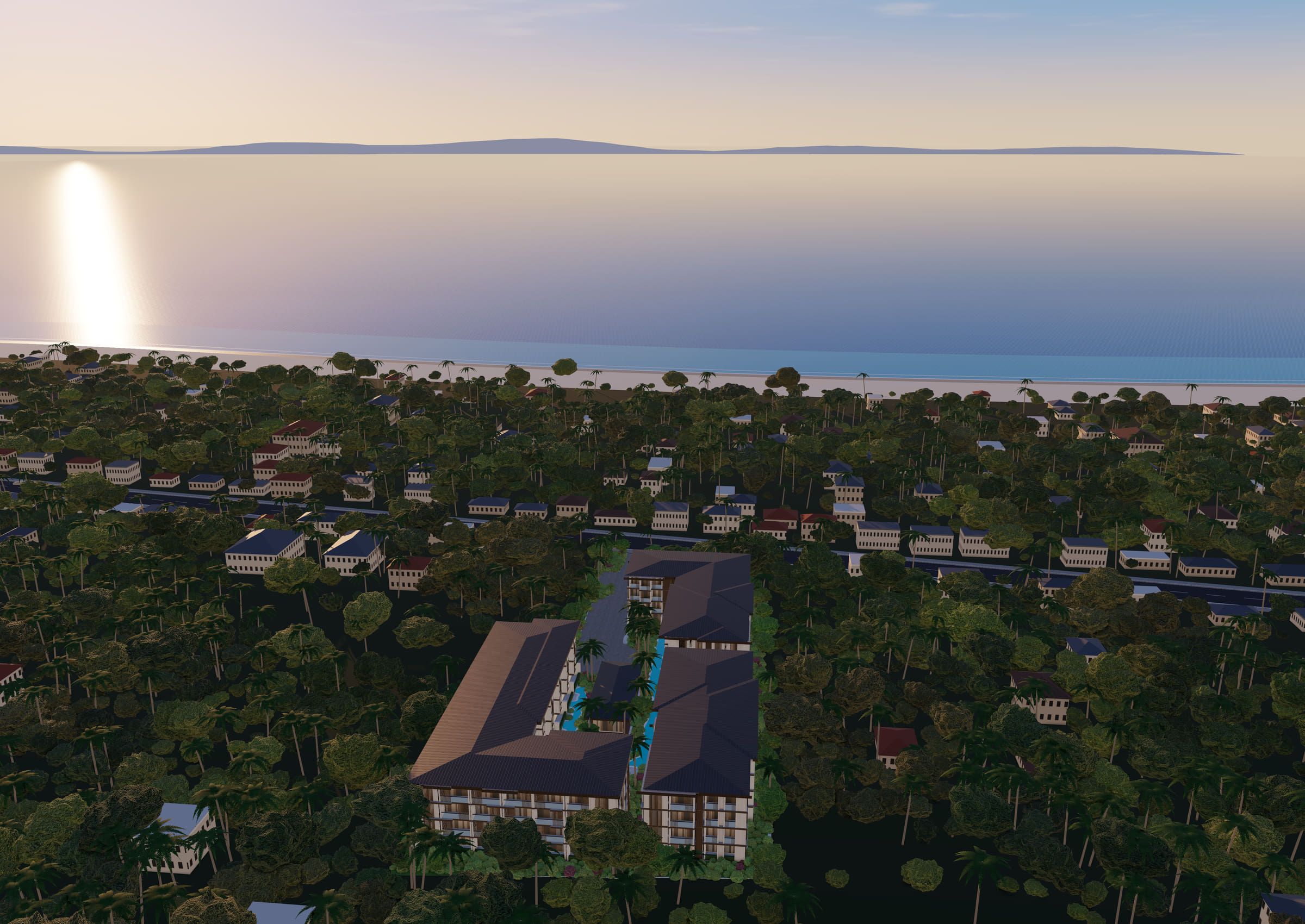

Choose your apartment in 3D
Open the 3D model of the development, pick a building and a floor, and see where each apartment sits and which way it faces.