How to calculate rental yield on a Thailand condo: gross vs net, step by step
Rental yield is a year of rent, minus the costs of earning it, divided by what you paid. This guide gives the method and the cost lines to count, with the fixed charges at The Astra Samui worked out in baht. It gives no yield figure and no sample rents, because we have no sourced ones.


To calculate rental yield on a Thailand condo, add up a year of rent you actually received, subtract the costs of earning it, and divide the result by what the apartment cost you in total. Divide before the costs and you have the gross yield. Divide after them and you have the net yield. The sum is simple. The hard part is knowing which numbers belong in it, and that is what this guide covers.
This is a guide to the method, not a forecast. We do not publish a yield figure for The Astra Samui, we show no sample rents, and the project promises no rental income. What we can do is set out every line you should count, show the fixed charges for The Astra Samui worked out for the smallest and the largest apartment, and give you the questions to ask any manager or seller who quotes you a number. For a wider look at the project from an owner’s side, see our investment page.
At a glance
- Gross yield is a year of rent divided by what you paid. Net yield is the same sum after the costs. Net is the lower one.
- Count rent received, not rent possible. Empty months, discounts and unpaid bills belong in the sum.
- Costs to count: the building’s common area fee, a one-off sinking fund, the manager, cleaning, utilities, insurance, local property tax, income tax, repairs, furniture, platform and payment fees, currency conversion.
- The Astra Samui has two fixed charges you can work out today: Common area fee: THB 50 per m² per month (12 months paid in advance) and Sinking fund: THB 500 per m², one-off.
- No rental income is promised. There is no hotel programme.
- Taxes on rent depend on your residence and your situation. Get advice from a Thai tax adviser and one in your home country.
What rental yield means
Rental yield compares what an apartment earns in rent over a year with what it cost to own. It is a ratio, so it lets you compare two apartments of different sizes or prices. It does not tell you how much money you will have in your account, and it says nothing about whether the price of the apartment will rise or fall.
Two things make the figure easy to misuse. The first is the choice of top line: rent the apartment could earn on a perfect calendar, rent it earned in a good year, or rent it earned over three years including a bad one. The second is the choice of bottom line: the price on the contract, or the price plus everything you paid to buy and furnish it. A yield quoted without both choices stated is not a figure you can compare with anything.
Websites that list condos often show a gross yield next to the price, and that is understandable, since gross is the higher figure. It is not wrong. It is just not the money you keep. When you meet a yield figure, ask whether it is gross or net, what rent it assumes, and what price it divides by.
Gross vs net rental yield
The two figures differ only in what you take off before you divide.
| Gross yield | Net yield | |
|---|---|---|
| Top line | A year of rent | A year of rent minus the costs of earning it |
| Bottom line | The price you paid (or total outlay) | The same |
| Costs deducted | None | Fees, management, cleaning, utilities, insurance, taxes, repairs, empty months |
| What it tells you | How hard the rent works against the price | How much of the rent you keep |
| Always the higher of the two | Yes | No |
If a seller or manager quotes you a single yield figure and does not say which kind it is, assume it is gross until they show you otherwise. Ask for the calculation behind it in writing, line by line.
The formula in words
Write the calculation as five steps. Do it first on paper with your own assumptions, and only then compare it with anyone else’s.
- Gross rental income for the year equals the nightly or monthly rate, multiplied by the number of nights or months the apartment was actually let.
- Occupancy is the share of the year the apartment was let. It is what turns a rate into income. Four months empty is a third of a year with no rent and the same bills.
- Operating costs for the year are everything you pay to keep the apartment open and let, listed below.
- Net operating income equals gross rental income minus operating costs.
- Net yield equals net operating income divided by your total outlay, and gross yield equals gross rental income divided by the same outlay.
For the bottom line, use your total outlay, not only the price. That means the contract price, the transfer fees and taxes you paid, any legal fees, the furniture and the cost of getting the apartment ready to let. Our guide to the costs of buying a condo in Thailand lists the purchase-side charges.
Which costs to count
Every cost below lowers the net figure. Some are fixed, some depend on how you let, and some are one-offs that you spread over the years you expect to hold the apartment.
Costs set by the building
- Common area fee. The monthly charge that pays for the building’s shared areas and upkeep. At The Astra Samui it is Common area fee: THB 50 per m² per month (12 months paid in advance). It is due whether or not the apartment is let.
- Sinking fund. A one-off charge into a reserve for future major repairs. At The Astra Samui it is Sinking fund: THB 500 per m², one-off. It is paid once, so spread it over the years you plan to own, or treat it as part of your total outlay.
- Utilities. Electricity, water and internet. If you let, you often pay them while the apartment is empty, for the air-conditioning, the router and the pump. Our guide to the cost of living on Koh Samui shows how we price electricity from the published tariff.
Costs of letting
- Management. A manager who finds guests, handles check-in, deals with repairs and collects the money. How managers charge differs, and we describe the models in our guide to rental management on Koh Samui.
- Cleaning and laundry after every stay. For short stays this repeats often, and it is a real line in the sum.
- Platform and payment fees, if you take bookings through an online platform. Read the host fee terms of the platform you will use, because they change.
- Marketing and photography, if you pay for them separately.
- Insurance on the contents and, if you can get it, on liability to guests. Ask the building what its own policy covers, because it will not cover your furniture.
Costs of ownership
- Local property tax. Thailand has a recurring local tax on land and buildings. Whether it applies to your apartment, at what rate and with what exemptions, we do not state, because we have not confirmed it from a primary source. Ask your adviser and the local office.
- Repairs and replacement. Linen, towels, kitchenware, small appliances and air-conditioning wear out faster in a let apartment. Our guide to furnishing a condo for rent lists what to plan for.
- Furniture and fit-out, if you buy it separately from the apartment, as a one-off at the start.
- Accounting and filing, if you pay someone to prepare your return.
Taxes on the rent
Rent can be taxable income in Thailand and in your country of residence, and the rules depend on who you are and how you let. We are not tax advisers and we do not state rates or thresholds here. Take your figures to a Thai tax adviser and to one in your home country, and put the tax they confirm into the sum as its own line. A yield calculated before tax is a pre-tax figure and should be labelled that way.
Currency
If you earn rent in baht and your life is in euros, pounds, dollars or złoty, the exchange rate and the conversion fee are a cost. A rate that moves against you between the day you buy and the day you take the money home changes the result without anything happening to the apartment. Work in baht first, then convert, and note the date of the rate you used.
Empty months and seasonality
On an island like Koh Samui, demand is not the same in every month, and weather is one reason. Our Koh Samui weather by month guide reads the Thai Meteorological Department’s climate normals, in which the last quarter of the year is the wettest. We cannot say how that affects bookings, because we have no occupancy data we trust. What we can say is that a calendar with no gaps is not a safe assumption. Test your calculation with several months empty, and then with more.
A worked example: the fixed charges at The Astra Samui
The two charges that the building sets are the part of the sum you can calculate today. Everything else on the list depends on how you let and who you use.
The apartments at The Astra Samui range over about 26–73 m², according to the developer. The table below uses the two ends of that range, the smallest and the largest apartment, and multiplies each by the published per-square-metre charges. The area on which the charges are calculated is stated in your contract, so check it against your apartment, because we have not confirmed whether the area includes the balcony.
| Charge | Smallest apartment | Largest apartment |
|---|---|---|
| Common area fee per month | THB 1,300 | THB 3,650 |
| Common area fee for a year | THB 15,600 | THB 43,800 |
| Sinking fund, one-off | THB 13,000 | THB 36,500 |


How the sums work. The common area fee is the monthly charge per square metre times the area, so the smallest apartment pays 50 times its area each month, and the largest does the same with its own. The fee is paid 12 months in advance, so the figure for a year is also the first payment. The sinking fund is the per-square-metre amount times the area, paid once.
These are only the building’s charges. They are not the cost of owning and letting. To get to a net figure you would add the management, cleaning, utilities, insurance, property tax and income tax lines above, and then subtract the sum from your own estimate of rent received. We do not give that estimate, and we recommend you do not take one from anyone who cannot show how they reached it.
A good way to use the table is to build a spreadsheet with one row for each cost line, a column for each year, and a separate scenario for a slow year. Put in only numbers you can source, mark each estimate as an estimate, and keep a note of the date.
Why we do not publish rental forecasts
We publish no yield, no sample rent and no projected income for The Astra Samui, and there are three reasons.
First, we have no source we can check. An occupancy figure or a nightly rate that comes from a brochure, a seller or a listing site is a claim, not a measurement, and we would have to print it as ours. What is for sale on the island today is covered, without price forecasts, in our overview of the Koh Samui property market.
Second, it would not be neutral. We are the sales agent for The Astra Samui, so a yield figure from us would be advertising dressed as analysis. A buyer should not have to wonder whether the number was chosen to help sell.
Third, the project is under construction and is sold off-plan, with handover planned for December 2028. That is a target, not a guarantee. A building that is not open has no booking history, so any rental figure for it is an assumption about the future.
On the rental model itself, two facts are published. You can let your residence yourself or through a rental management company. No rental income is promised. There is no hotel programme. If you hear otherwise from anyone, ask them to put it in writing and send it to us.
How to read a promised return
You will meet some version of a promised payout in the property market, in Thailand and elsewhere: a fixed annual payment to the owner for a number of years, a rental pool, a hotel programme, or a buy-back at a stated price. Treat each of these as a contract term to be read, not as a fact about how the market behaves.
A short test helps. Take the claim apart into five questions.
- Who pays? A named company, with its registered name and number, or an unnamed one. Does the payer have the assets to pay if the apartment earns nothing?
- From what? Out of rent actually earned, or out of the money you paid for the apartment? If the latter, the payment is a discount on the price in disguise.
- For how long? A fixed term, then what happens? Find out what you are left with when the promise ends.
- At what price? Is the promised payout built into a higher price per square metre? Compare the price with that of similar apartments without the promise.
- What can you do if it stops? Which law, which court, which security? Is any of it enforceable against a company in another country?
If you cannot answer all five from the documents, the claim is not ready for you to rely on. This is general information, not legal advice, and a Thai lawyer should read any contract that carries a promised payout before you sign.
Questions to ask a rental manager
Put these to every manager you consider, and keep the answers in writing. A manager who answers clearly is easier to compare, and one who avoids the questions has told you something too.
- What exactly do you charge, in what form, and on what base (rent, nights, a flat monthly amount)? Is there any charge on top?
- What is the payment cycle, and when does the money reach me, in what currency and by what route?
- What was the occupancy of apartments like mine in your care, by month, over the last two years? Can you show reports, with the names of the owners removed?
- Which costs do I pay on top of your fee, such as cleaning, laundry, repairs, utilities, supplies and platform fees? Who decides on a repair, and above what amount do you ask me first?
- Do you hold the licences the type of letting needs, and can I see them? Who reports guests to immigration?
- What does the contract say about ending it, about my own stays, about damage caused by guests and about a sale of the apartment?
- Which platforms, and which guests, do you take? Do you use my own photographs, and who owns the listing and the reviews if I leave?
- Who looks after the apartment when it is empty in the wet months, to run the air-conditioning and check for damp?
Our guide to rental management on Koh Samui goes through these points one by one, including the contract.
Rental yield at The Astra Samui
The Astra Samui is low-rise, resort-style condominium in Bophut on Koh Samui, sold by Varsovia Estate, the sales agent for The Astra Samui. It is a project for buyers who want to understand the numbers before they commit, and we would rather you did the sum yourself than trust ours. We have given you the fixed charges, the structure of the calculation and the questions. The things we cannot give you are rents, occupancy and income, because none of them has a source we can check.
If you want to see how an apartment type fits your plan, look at the apartment types and layouts, which show the sizes the charges above apply to. The prices page shows what the apartments cost, with the project price starting from THB 3,700,000 (about €98,000, NBP average rate of 23 October 2026), and the how to buy page sets out the steps from reservation to handover. If you would like to talk it through with a person, book a call and bring your own calculation. We will check the fixed charges with you for the apartment you are considering.
Once you have your numbers, the checklist on furnishing a condo for rent will tell you what the apartment needs to be ready for guests.
Questions and answers
How do you calculate rental yield on a condo in Thailand?
Add up a year of rent actually received, subtract the costs of earning it, and divide by what the apartment cost you. Divide before the costs and you get gross yield. Divide after them and you get net yield. The costs include the building’s common area fee, the manager, cleaning, utilities, insurance, local property tax, income tax and empty months.
What is the difference between gross and net rental yield?
Gross yield uses the rent before any costs. Net yield uses what is left after the costs of owning and letting the apartment. Gross is always the higher of the two, which is why advertisements prefer it. Net is the one that describes money you can actually spend, so ask for both and check which one a quoted figure is.
What costs should I include when working out rental yield?
Count the common area fee, the sinking fund, the management fee, cleaning and laundry, utilities, insurance, property taxes, income tax on the rent, repairs and replacement of furniture, platform and payment fees, currency conversion and the months the apartment is empty. Leave out none of them, because each one lowers the net figure.
Does The Astra Samui publish a rental yield?
No. The Astra Samui has no hotel programme and promises no rental income, and we publish no yield forecast. What we can publish are fixed charges, such as the common area fee and the one-off sinking fund, so that you can do the sum with your own rent assumptions.
Is a promised fixed payout from a Thai condo safe to rely on?
Treat any promised payout as a contract term to read, not as a fact about the market. Ask who pays it, from what, for how long, what happens if the payer cannot, and whether it is built into the price you pay. The Astra Samui offers no such scheme.
How much rent can a condo on Koh Samui earn?
We cannot say, because we have no sourced figure and publish no rent forecasts. Rent depends on the apartment, the building, the season, how you let it and who manages it. Ask a management company for its own occupancy and rates by month, in writing, and treat them as that company’s claim.
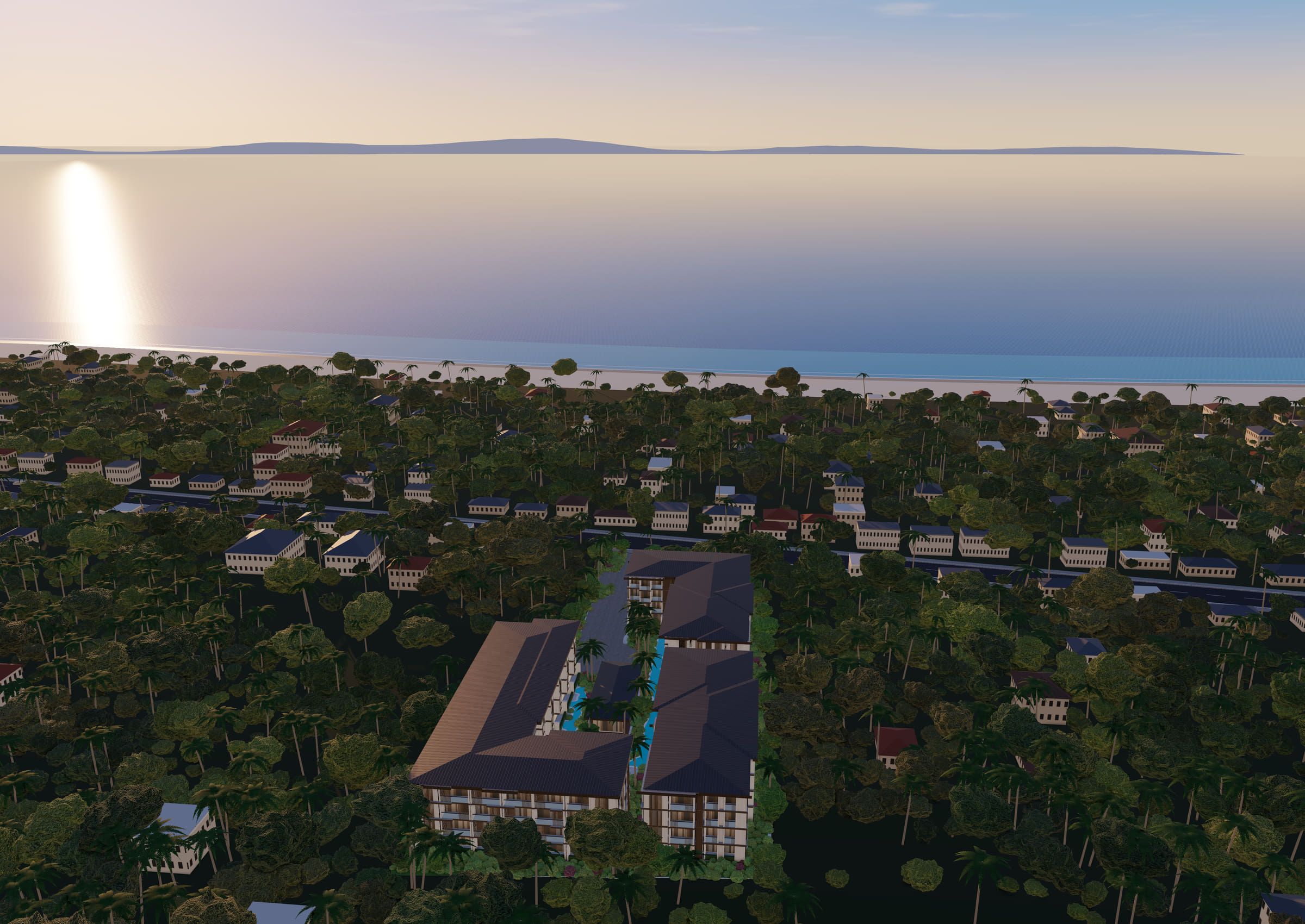

Choose your apartment in 3D
Open the 3D model of the development, pick a building and a floor, and see where each apartment sits and which way it faces.